
David Walters
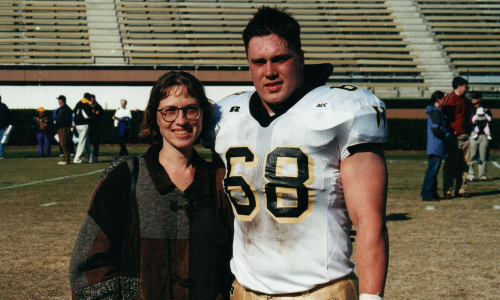
David was born on March 3, 1980, at 9:06 p.m. He weighed 10 lbs. 1oz and was 22 ½” long. My first born and only son. My dream came true: I was a mom! As I held and cuddled my sweet baby, for the first time alone, I whispered how much I loved him and all the plans I had for him; stroller walks to the park, birthday parties, trips to the zoo, and the vow to always protect him from any harm. He was my little angel, my blessing from God. I was a stay-at-home mom. I was going to be there to see all his firsts!
David was a good-natured person. He was kind and gentle with others with a good sense of humor. He was a devout man of God, protective of his family, adored his niece, a true friend, loved animals, and had a bonding way with autistic children. David took strong interest in several sports at a young age beginning with baseball, then paintball, mountain biking, weightlifting, and football.
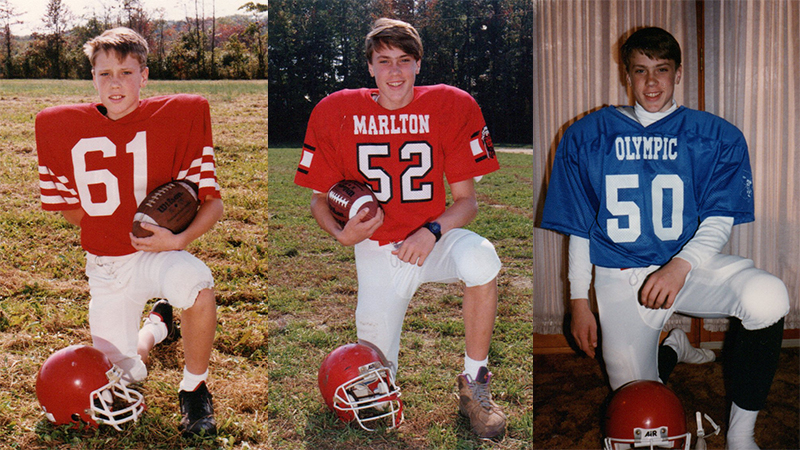
David began midget football at age 11. When he was a young teen, his grandfather instilled in him the importance of finding something he liked to do, be it a sport or occupation, and giving it his all. David loved football and he learned that weightlifting would make him better at it, so lifting weights became a passion. David’s excellence in the weight room at Cherokee High School in Marlton, New Jersey earned him offensive playing time on the football team all four years.
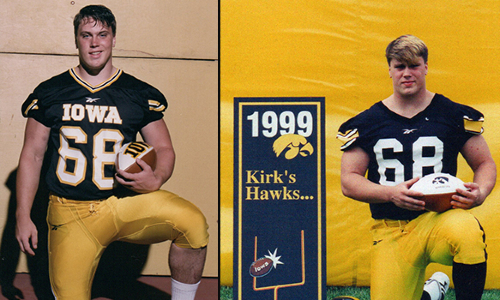
His hard work in high school paid off. He was offered 11 Division I football scholarships, including one Big Ten offer. David committed to the University of Iowa the summer before his senior year of high school.
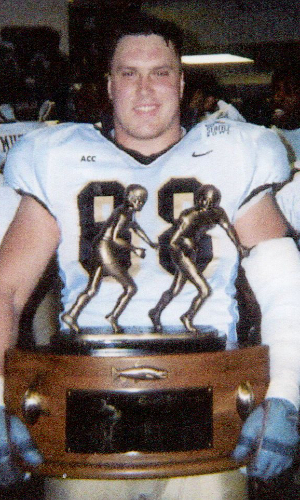
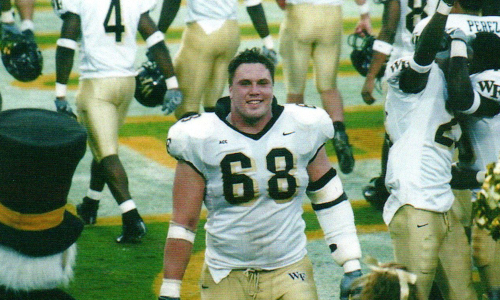
When a new coaching staff began in Iowa, David decided to transfer to Wake Forest University in North Carolina. He began his career as a Demon Deacon in 2000. He continued to excel in the weight room and became an impact player, receiving and delivering big hits every game. He stood out for his last two seasons playing offensive tackle.
During the 2002 season, David received a severe concussion during a game but somehow continued playing to the game’s end. He was cleared medically to play the next game, the remainder of the season, and the Seattle Bowl game. I think this final season was the beginning of the end.
After graduating from Wake Forest with a degree in sociology, David went on to play professionally for the Canadian Football League’s Montreal Alouettes. When the CFL decided to let go of almost all their American offensive players, David moved to central Florida where he pursued a career in weight training and nutrition. David did everything he could to stay on his feet, but he struggled to manage the pain he accumulated from years of football.
Eventually, David re-settled in New Jersey. He married and began a new profession as a bricklayer and stone mason. His pain continued, though, and he was caught in a slow but nightmarish spiral of pain and addiction to pain pills.
In 2008, when David was 28, he was diagnosed with Post-Concussion Syndrome. His neurologist described the years of damage as “a lightning storm” in his brain. Talking through David’s concussion history, they estimated 11 concussions or more over his career. He was at high risk for developing serious cognitive issues later in life, and he was facing incredible pain.
Within three years, David’s marriage crumbled. He moved back home with me in 2012 as his pain grew worse. David developed rheumatoid, osteo, and psoriatic arthritis at a young age because of the abuse his body took, and treatments offered little relief. David underwent three unsuccessful surgeries to fix his knees. Then an unsuccessful elbow surgery, leaving him with no cartilage and the elbow of an 80-year-old man. He was told he needed shoulder surgery but couldn’t get around to it because of the constant pain in his head and body.
Through all of this, David’s memory declined to a frightening stage. His difficulties went from “What did I eat for my last meal?” to “I don’t remember Dad giving me this living room set for when I am able to move out on my own again.” His moods grew worse, and he felt extreme irritation over trivial matters. And there were seizures. More and more small seizures, four Grand Mal Seizures, and increasing aggression and violent behaviors.
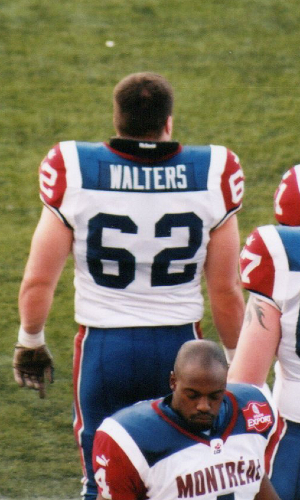
The kind, gentle, patient David that I knew, my true son, was almost gone. The sweet, appreciative, compassionate David, barely a part of who he’d become. His words in the beginning, when he was thinking about where he felt his life was going, still cause me to cry.
“If I ever have a son, I will never let him play football.”
“Mom, you know one of these seizures, I might not pull through. I don’t want to live like this anymore. I thought of killing myself twice now, but only stop because I don’t want you to come home and find me that way. I don’t want to hurt you Mom.”
David’s list of symptoms grew. Difficulty thinking, planning, and carrying out tasks. Short term memory loss, confusion, mood swings, and impulsive/erratic behavior. Loss of motor skills, tremors, and loss of balance. Aggression, irritability, suicidal thoughts, depression, and apathy.
“You’ve done everything to help me. You take me to all my doctor appointments. You are always encouraging me. You are the best Mom God could have ever given me. We’re a team. I love you, Mom. Thank you, Mom. You love me for me. You help me see things in a different light. I can’t stand the pain in my head. You could never understand the pain in my head. It won’t stop. I pray for God to take me.”
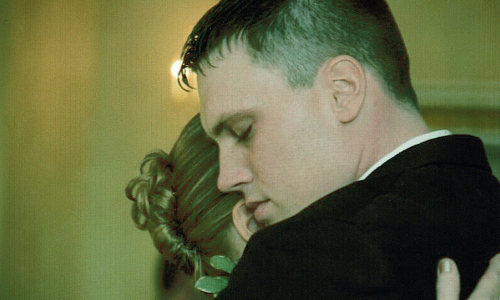
In July 2016, David’s internal rage had become almost completely external. I had to do the most difficult thing in my life. I could no longer care for my slowly dissolving son. I could no longer allow him to continue living in my home. He had to go out on his own, as pathetic as that now feels to say.
He struggled but survived on his own for two more years. I had a pipeline to God’s ears more than ever. Please Lord, make David’s pain stop; please Lord, help him, please, please, please.
David’s downward spiral started because his pain from concussions and other injuries was too much to bear. The college medical staff administered opioids, which we know can lead to addiction. Then, controlled opioids by doctors outside of collegiate walls; addiction. Rehab. Clean. More pain. More opioids. Addiction. Clean. Surgeries. Confusion. Rage. Pain. Out of control pain. Accidental opioid overdose …
On Monday, July 23, 2018 at 9:15 p.m., four days before my 61st birthday, I received every parent’s nightmare phone call. My son, my boy, my beautiful boy, my baby, was gone. God answered my prayers and David’s prayers; David’s pain was no more. No more pain in his head, no more pain in his broken body due to football. He is with his beloved grandparents and great-uncle. He is living in glory with our Lord. This is not how I wanted this prayer to be answered, in this way, but it is what God had planned for my David.
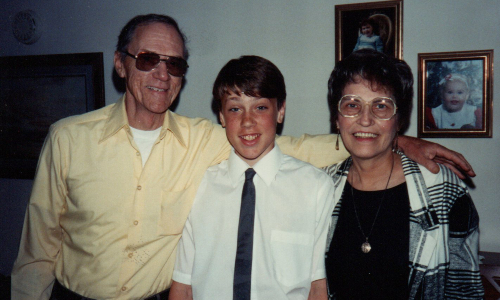
I am still, a year later, trying to accept my loss. I can only hope to help others who are dealing with PCS and suspected CTE in their loved one, to let them know they are not alone. I am here to help in anyway I can through listening and sympathizing with my whole heart. To honor David in the way he would have wanted; to help others on his behalf. The last outward sign of my love for him. David wanted to donate his brain to science, but we were unable to follow through on this wish. I feel David would be happy to know I am trying to spread the word and help others like him. When David passed, in lieu of flowers, a request for donations in his name to the Concussion & CTE Foundation was set up. He would be proud that so many good people who loved him have donated.
David found his soul mate the year before he passed. He was to start his dream job the day after he passed, in a hospital where plans for a flourishing new career were to begin. A few days after David passed, he came to me in the most vivid dream. I try to remember it in my times of uncontrollable grief; he is standing in front of me, smiling, arms wide open saying, “I’m ok Mom.” I know he is, but I am not. I am grateful for all the Concussion & CTE Foundation has, is, and will be doing for our afflicted loved ones, and for us, their parents, family and friends.
Are you or someone you know struggling with lingering concussion symptoms or what you believe may be CTE? We support patients and families through the Concussion & CTE Foundation HelpLine, which provides personalized help to those struggling with the outcomes of brain injury. If you are seeking guidance on how to choose the right doctor, find educational resources, or have any other specific questions, we want to hear from you. Submit your request to the HelpLine and a dedicated member of the Concussion & CTE Foundation team will be happy to assist you.
Joe Walton
Andre Waters
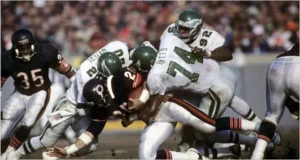
Since the former National Football League player Andre Waters killed himself in November, an explanation for his suicide has remained a mystery. But after examining remains of Mr. Waters’s brain, a neuropathologist in Pittsburgh is claiming that Mr. Waters had sustained brain damage from playing football and he says that led to his depression and ultimate death.
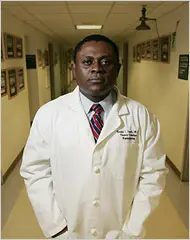
The neuropathologist, Dr. Bennet Omalu of the University of Pittsburgh, a leading expert in forensic pathology, determined that Mr. Waters’s brain tissue had degenerated into that of an 85-year-old man with similar characteristics as those of early-stage Alzheimer’s victims. Dr. Omalu said he believed that the damage was either caused or drastically expedited by successive concussions Mr. Waters, 44, had sustained playing football.
In a telephone interview, Dr. Omalu said that brain trauma “is the significant contributory factor” to Mr. Waters’s brain damage, “no matter how you look at it, distort it, bend it. It’s the significant forensic factor given the global scenario.”
He added that although he planned further investigation, the depression that family members recalled Mr. Waters exhibiting in his final years was almost certainly exacerbated, if not caused, by the state of his brain — and that if he had lived, within 10 or 15 years “Andre Waters would have been fully incapacitated.”
Dr. Omalu’s claims of Mr. Waters’s brain deterioration — which have not been corroborated or reviewed — add to the mounting scientific debate over whether victims of multiple concussions, and specifically longtime N.F.L. players who may or may not know their full history of brain trauma, are at heightened risk of depression, dementia and suicide as early as midlife.
The N.F.L. declined to comment on Mr. Waters’s case specifically. A member of the league’s mild traumatic brain injury committee, Dr. Andrew Tucker, said that the N.F.L. was beginning a study of retired players later this year to examine the more general issue of football concussions and subsequent depression.
“The picture is not really complete until we have the opportunity to look at the same group of people over time,” said Dr. Tucker, also team physician of the Baltimore Ravens.
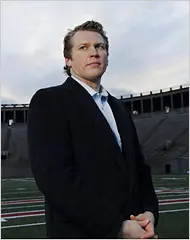
The Waters discovery began solely on the hunch of Chris Nowinski, a former Harvard football player and professional wrestler whose repeated concussions ended his career, left him with severe migraines and depression, and compelled him to expose the effects of contact-sport brain trauma. After hearing of the suicide, Mr. Nowinski phoned Mr. Waters’s sister Sandra Pinkney with a ghoulish request: to borrow the remains of her brother’s brain.
The condition that Mr. Nowinski suspected might be found in Mr. Waters’s brain cannot be revealed by a scan of a living person; brain tissue must be examined under a microscope. “You don’t usually get brains to examine of 44-year-old ex-football players who likely had depression and who have committed suicide,” Mr. Nowinski said. “It’s extremely rare.”
Editors’ Picks
How to Ensure a Peaceful Trip With Your Extended Family
Will Free Beer Make Travelers More Responsible?
Can I Confront the Woman Who Stole My Late Sister’s Evening Gowns?
As Ms. Pinkney listened to Mr. Nowinski explain his rationale, she realized that the request was less creepy than credible. Her family wondered why Mr. Waters, a hard-hitting N.F.L. safety from 1984 to 1995 known as a generally gregarious and giving man, spiraled down to the point of killing himself.
Ms. Pinkney signed the release forms in mid-December, allowing Mr. Nowinski to have four pieces of Mr. Waters’s brain shipped overnight in formaldehyde from the Hillsborough County, Fla., medical examiner’s office to Dr. Omalu in Pittsburgh for examination.
He chose Dr. Omalu both for his expertise in the field of neuropathology and for his rare experience in the football industry. Because he was coincidentally situated in Pittsburgh, he had examined the brains of two former Pittsburgh Steelers players who were discovered to have had postconcussive brain dysfunction: Mike Webster, who became homeless and cognitively impaired before dying of heart failure in 2002; and Terry Long, who committed suicide in 2005.
Mr. Nowinski, a former World Wrestling Entertainment star working in Boston as a pharmaceutical consultant, and the Waters family have spent the last six weeks becoming unlikely friends and allies. Each wants to sound an alarm to athletes and their families that repeated concussions can, some 20 years after the fact, have devastating consequences if left unrecognized and untreated — a stance already taken in some scientific journals.
“The young kids need to understand; the parents need to be taught,” said Kwana Pittman, 31, Mr. Waters’s niece and an administrator at the water company near her home in Pahokee, Fla. “I just want there to be more teaching and for them to take the proper steps as far as treating them.
“Don’t send them back out on these fields. They boost it up in their heads that, you know, ‘You tough, you tough.’ ”
Mr. Nowinski was one of those tough kids. As an all-Ivy League defensive tackle at Harvard in the late 1990s, he sustained two concussions, though like many athletes he did not report them to his coaches because he neither understood their severity nor wanted to appear weak. As a professional wrestler he sustained four more, forcing him to retire in 2004. After he developed severe migraines and depression, he wanted to learn more about concussions and their effects.
That research resulted in a book published last year, “Head Games: Football’s Concussion Crisis,” in which he detailed both public misunderstanding of concussions as well as what he called “the N.F.L.’s tobacco-industry-like refusal to acknowledge the depths of the problem.”
Football’s machismo has long euphemized concussions as bell-ringers or dings, but what also alarmed Mr. Nowinski, 28, was that studies conducted by the N.F.L. on the effects of concussions in players “went against just about every study on sports concussions published in the last 20 years.”
Studies of more than 2,500 former N.F.L. players by the Center for the Study of Retired Athletes, based at the University of North Carolina, found that cognitive impairment, Alzheimer’s-like symptoms and depression rose proportionately with the number of concussions they had sustained. That information, combined with the revelations that Mr. Webster and Mr. Long suffered from mental impairment before their deaths, compelled Mr. Nowinski to promote awareness of brain trauma’s latent effects.
Then, while at work on Nov. 20, he read on Sports Illustrated’s Web site, si.com, that Mr. Waters had shot himself in the head in his home in Tampa, Fla., early that morning. He read appraisals that Mr. Waters, who retired in 1995 and had spent many years as an assistant coach at several small colleges — including Fort Valley (Ga.) State last fall — had been an outwardly happy person despite his disappointment at not landing a coaching job in the N.F.L.
Remembering Mr. Waters’s reputation as one of football’s hardest-hitting defensive players while with the Philadelphia Eagles, and knowing what he did about the psychological effects of concussions, Mr. Nowinski searched the Internet for any such history Mr. Waters might have had.
It was striking, Mr. Nowinski said. Asked in 1994 by The Philadelphia Inquirer to count his career concussions, Mr. Waters replied, “I think I lost count at 15.” He later added: “I just wouldn’t say anything. I’d sniff some smelling salts, then go back in there.”
Mr. Nowinski also found a note in the Inquirer in 1991 about how Mr. Waters had been hospitalized after sustaining a concussion in a game against Tampa Bay and experiencing a seizure-like episode on the team plane that was later diagnosed as body cramps; Mr. Waters played the next week.
Because of Dr. Omalu’s experience on the Webster and Long cases, Mr. Nowinski wanted him to examine the remaining pieces of Mr. Waters’s brain — each about the size of a small plum — for signs of chronic traumatic encephalopathy, the tangled threads of abnormal proteins that have been found to cause cognitive and intellectual dysfunction, including major depression. Mr. Nowinski tracked down the local medical examiner responsible for Mr. Waters’s body, Dr. Leszek Chrostowski, who via e-mail initially doubted that concussions and suicide could be related.
Mr. Nowinski forwarded the Center for the Study of Retired Athletes’ studies and other materials, and after several weeks of back-and-forth was told that the few remains of Mr. Waters’s brain — which because Waters had committed suicide had been preserved for procedural forensic purposes before the burial — would be released only with his family’s permission.
Mr. Nowinski said his call to Mr. Waters’s mother, Willie Ola Perry, was “the most difficult cold-call I’ve ever been a part of.”
When Mr. Waters’s sister Tracy Lane returned Mr. Nowinski’s message, he told her, “I think there’s an outside chance that there might be more to the story.”
“I explained who I was, what I’ve been doing, and told her about Terry Long — and said there’s a long shot that this is a similar case,” Mr. Nowinski said.
Ms. Lane and another sister, Sandra Pinkney, researched Mr. Nowinski’s background, his expertise and experience with concussions, and decided to trust his desire to help other players.
“I said, ‘You know what, the only reason I’m doing this is because you were a victim,’ ” said Ms. Pittman, Mr. Waters’s niece. “I feel like when people have been through things that similar or same as another person, they can relate and their heart is in it more. Because they can feel what this other person is going through.”
Three weeks later, on Jan. 4, Dr. Omalu’s tests revealed that Mr. Waters’s brain resembled that of an octogenarian Alzheimer’s patient. Nowinski said he felt a dual rush — of sadness and success.
“Certainly a very large part of me was saddened,” he said. “I can only imagine with that much physical damage in your brain, what that must have felt like for him.” Then again, Mr. Nowinski does have an inkling.
“I have maybe a small window of understanding that other people don’t, just because I have certain bad days that when I know my brain doesn’t work as well as it does on other days — and I can tell,” he said. “But I know and I understand, and that helps me deal with it because I know it’ll probably be fine tomorrow. I don’t know what I would do if I didn’t know.”
When informed of the Waters findings, Dr. Julian Bailes, medical director for the Center for the Study of Retired Athletes and the chairman of the department of neurosurgery at West Virginia University, said, “Unfortunately, I’m not shocked.”
In a survey of more than 2,500 former players, the Center for the Study of Retired Athletes found that those who had sustained three or more concussions were three times more likely to experience “significant memory problems” and five times more likely to develop earlier onset of Alzheimer’s disease. A new study, to be published later this year, finds a similar relationship between sustaining three or more concussions and clinical depression.
Dr. Bailes and other experts have claimed the N.F.L. has minimized the risks of brain trauma at all levels of football by allowing players who sustain a concussion in games — like Jets wide receiver Laveranues Coles last month — to return to play the same day if they appear to have recovered. The N.F.L.’s mild traumatic brain injury committee has published several papers in the journal Neurosurgery defending that practice and unveiling its research that players from 1996 through 2001 who sustained three or more concussions “did not demonstrate evidence of neurocognitive decline.”
A primary criticism of these papers has been that the N.F.L. studied only active players, not retirees who had reached middle age. Dr. Mark Lovell, another member of the league’s committee, responded that a study using long-term testing and monitoring of the same players from relative youth to adulthood was necessary to properly assess the issue.
“We want to apply scientific rigor to this issue to make sure that we’re really getting at the underlying cause of what’s happening,” Dr. Lovell said. “You cannot tell that from a survey.”
Dr. Kevin Guskiewicz is the director of the Center for the Study of Retired Athletes and a member of U.N.C.’s department of exercise and sport science. He defended his organization’s research: “I think that some of the folks within the N.F.L. have chosen to ignore some of these earlier findings, and I question how many more, be it a large study like ours, or single-case studies like Terry Long, Mike Webster, whomever it may be, it will take for them to wake up.”
The N.F.L. players’ association, which helps finance the Center for the Study of Retired Athletes, did not return a phone call seeking comment on the Waters findings. But Merril Hoge, a former Pittsburgh Steelers running back and current ESPN analyst whose career was ended by severe concussions, said that all players — from retirees to active players to those in youth leagues — need better education about the risks of brain trauma.
“We understand, as players, the ramifications and dangers of paralysis for one reason — we see a person in a wheelchair and can identify with that visually,” said Mr. Hoge, 41, who played on the Steelers with Mr. Webster and Mr. Long. “When somebody has had brain trauma to a level that they do not function normally, we don’t see that. We don’t witness a person walking around lost or drooling or confused, because they can’t be out in society.”
Clearly, not all players with long concussion histories have met gruesome ends — the star quarterbacks Steve Young and Troy Aikman, for example, were forced to retire early after successive brain trauma and have not publicly acknowledged any problems. But the experiences of Mr. Hoge, Al Toon (the former Jets receiver who considered suicide after repeated concussions) and the unnamed retired players interviewed by the Center for the Study of Retired Athletes suggest that others have not sidestepped a collision with football’s less glorified legacy.
“We always had the question of why — why did my uncle do this?” said Ms. Pittman, Mr. Waters’s niece. “Chris told me to trust him with all these tests on the brain, that we could find out more and help other people. And he kept his word.”
John Watson
Allen Way

Al Way was a quiet, kind, humble man, to whom I am proud to say I shared 50 years of marriage. I met Al while in college at the University of Iowa. We married before our senior year and upon graduation he received his orders that he would be serving in the Army for the next two years of his life. He was outstanding trainee in basic training and then Leadership Graduate from Non Commissioned Officers school at Ft. Benning Georgia. He served as a Platoon Sergeant with status of E6 in the Infantry. His field of duty was predominately Ahn Khe Vietnam. During his service he experienced blasts from mortars, claymores, and bangalore torpedoes. He endured a twenty-foot fall from a cliff into a rock filled river and survived it, to get up and keep moving through the jungle. He returned home after his eleven-and-a-half-month deployment, to a new four-month-old daughter so he took on his new role immediately. Like many others returning from Vietnam, he carried on and went about the business of taking care of his family then welcoming another baby, a boy, followed by another daughter. Al excelled at all areas of his life, including serving his State of Iowa as the Director of the State Crime Commission, until he decided to strike out and run his own business as a beer distributor. He served his community as a City Councilman, volunteer for his children’s school, church and countless other organizations.

When he returned from Vietnam there were some more subtle personality changes, but you would expect this from someone returning from combat duty. I would not know for several years later some of the traumatic experiences, both psychological and physical, that he had experienced. When Al started therapy at our local VA clinic he shared some of what he and others in his company had endured.
After retirement I noted increasing depression and anxiety in Al. We then were later blessed with a Veteran’s Clinic opening in our community. He started to receive service when he needed it most; medications, one on one counseling, and a PTSD group. Once again, he volunteered at the clinic to help others who were struggling as he was. A few years later there were CT scans which found a Traumatic Brain Injury. His depression increased as time went on, but he was sharing more of his experiences. He had increased paranoia, flashbacks, and night terrors. He had great difficulty remembering names, schedules and directions. He was a great woodworker, but it became a task for him to build anything. He would measure, re-measure, give up and try again. These were all things that came so easy to him in the past. Even with all the supports and numerous evaluations he seemed to be getting worse. He lost his balance on more than one occasion and would have falls that resulted in the need for emergency room visits and stitches.
On the evening of August 28, 2017, after helping me prepare supper, he washed dishes, made coffee for the next morning, and while I was gone from the house on a short walk, he took his life. I had thought that a man of his 71 years would not have the energy to do this, but I was wrong. There were no unusual behaviors on that day which would have warned me or anyone else he talked to that day.
After Al’s suicide, the deputy State Medical Examiner at the Iowa Department of Public Health called and suggested that we consider donating Al’s brain to the Boston University CTE Study. My three children and I did not hesitate to say yes. We went through three interviews, of which there were two conference calls and one written questionnaire. These were followed by a consensus conference with both the medical team and the psychological team. I was fearful that they would talk about my husband as if he were a clinical study, a file folder. We were comforted by the respectful way they discussed Al and his history. The staff at BU spoke of him as a person, who was loved with a story prior to being ill, a loving son, brother, husband, father of three and grandfather of nine. My family and I have great respect for all members of the research team. They were honoring Al in this process, not analyzing him. The findings were that my husband, Al, had stage III/IV Chronic Traumatic Encephalopathy (CTE). Now we know how very much he was struggling but kept going for his family as long as he did.
He continues to help others as he did in his earthly life and we are all so proud of him and honored that he is now part of the study. The CTE study was part of our healing during our time of grief. Despite all the heart break and trauma, my three children and I are greatly blessed to have had him for so many years.