Meiko Locksley
Michael Lopez
Michael Louis
Gerald Luchau
Rob Lytle
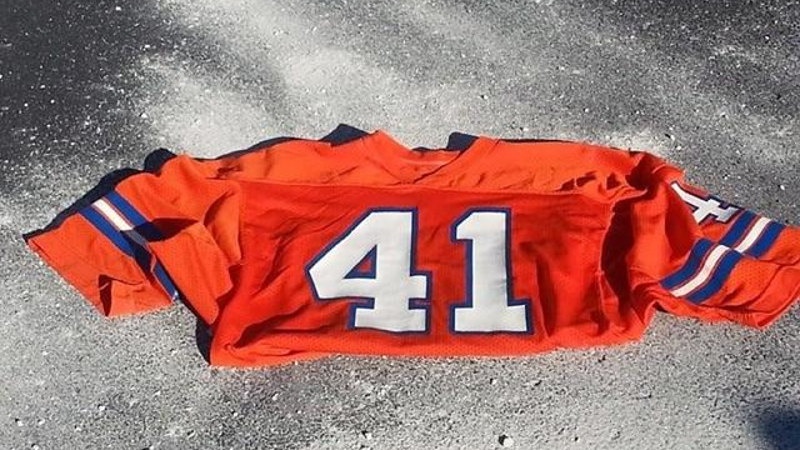
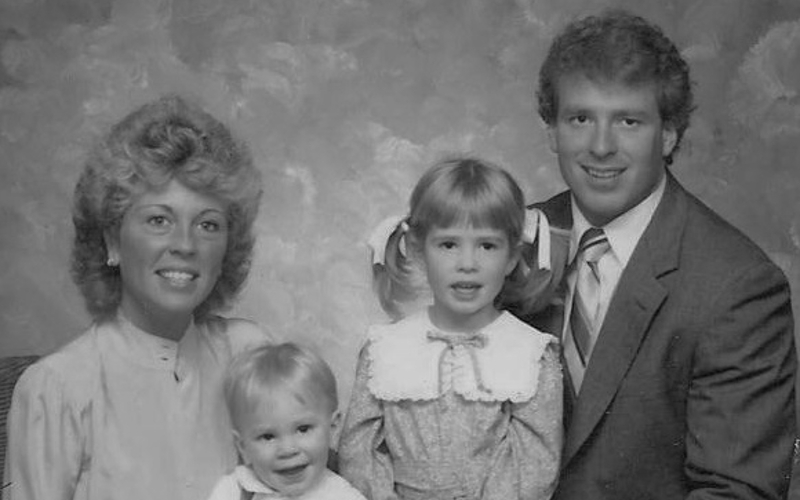
Adding 11 + 20 + 10 gives you 41. My husband, Rob Lytle, wore number 41 on the football field for the Fremont Ross Little Giants, Michigan Wolverines, and Denver Broncos. He wore it in the Rose Bowl and the Super Bowl. Rob died on November 20, 2010. How heartbreaking that he would die on this day.
The events of that day weigh on my heart. Our daughter, Erin, and I were shopping in Columbus. I had left Fremont—the small Ohio town where Rob and I lived—in the morning before Rob was awake. Never a morning person, lately rising from bed and starting a new day had become almost more than he could bear. While leaving town, though, I realized I had forgotten something. At home, I caught Rob freshly awake and struggling to walk down the stairs. As he descended the stairs, I watched his knees refuse to bend. He leaned against the railing, which strained and wobbled loose from the wall, failing against the weight of supporting my suffering husband. Rob grimaced. His many years of football had devastated his body. My heart winced.
Knee operations in the teens had led to an artificial left knee and multiple shoulder surgeries had led to an artificial right shoulder. Rob had mangled fingers that pointed in all different directions. He suffered from vertigo, incessant migraines, and eighteen months earlier had survived a stroke. In recent months, his mood had soured and his spirit seemed beaten. He was distant and depressed—forgetful and lost in our conversations—a cloudy shade of the man I had loved for forty years.
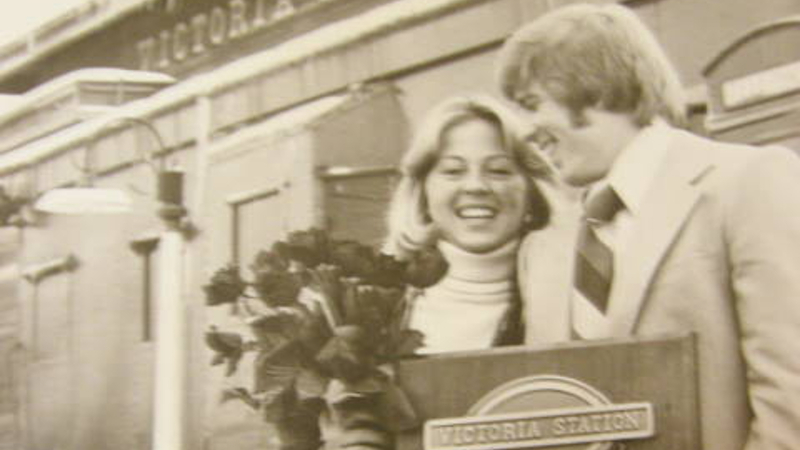
Standing together in the kitchen, Rob prepared to devour a breakfast quiche of eggs, cheese, and sausage. I fussed with a Christmas setting on the table. Just the night before we had carried eight loads of Christmas decorations down three flights of stairs while carols sang on the radio in the background. I kissed Rob goodbye before his first bite, not realizing that this would be my last contact with him.
Every moment in life is precious.
While shopping, Erin and I got the call that Rob had had a heart attack. Life flashed before me. I saw our first kiss and first dance, our last fight and last hug. Was Rob alive? The doctors wouldn’t share anything over the phone. I prayed, wept, and hoped as Erin drove us two hours north from Columbus to Fremont.
Once at the hospital, Erin and I were joined by Kelly (Rob and I’s son). A young doctor ushered us into a conference room. I will never forget the sight of my children falling to the floor in anguish as we heard the news. Our Rob—my Rob—had died. They had just lost their hero, and I had just lost my husband.
The next day, Concussion & CTE Foundation (then the Sports Legacy Institute) called and asked if we would donate Rob’s brain for their research on head trauma. I had never heard of them or the cause before the call. Rob played in an era when a concussion meant only that you had had your bell rung and where the first fix for an injury was to rub some dirt on it while the second was a series of painkilling injections.
Still, Rob had mentioned many times in conversation that he suffered at least twenty-four concussions that he remembered during his career. One stood out, and I can remember us laughing about it. In 1978, during the AFC Championship game versus the Oakland Raiders, Rob had smashed into Jack Tatum near the end zone and fumbled. Except the referees disagreed and ruled that Rob was down before he lost the ball. Oakland coach John Madden fumed it was a fumble and sprinted along the sidelines screaming at officials. Denver scored a touchdown on the next play, won the AFC title, and played in Super Bowl XII.
In our talks, Rob had told me he didn’t know what happened on the play because he had been “out cold.” He also admitted that he remembered little of the AFC Championship because of the concussion he suffered versus Pittsburgh one week earlier. “I had to play, Tracy,” I can remember Rob saying.
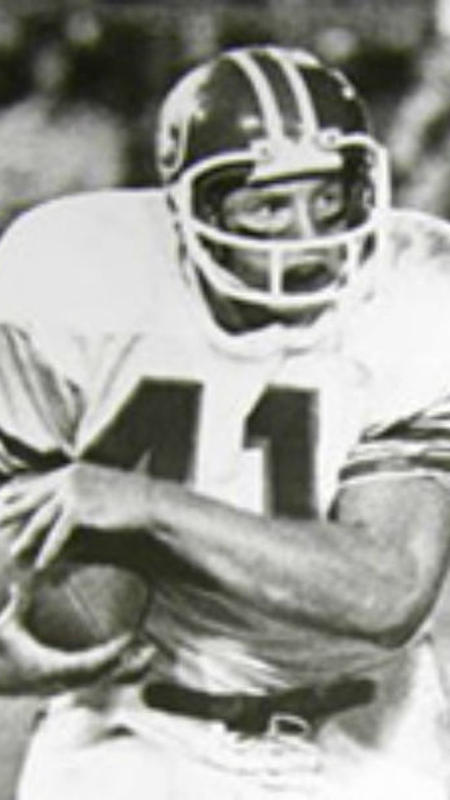
Never did I think that all these concussions could have caused Rob’s changing personality. Rob and I recognized how football had abused him physically and emotionally. What we never realized was the mental destruction the game caused. After the Foundation studied his brain, doctors diagnosed Rob with moderate-to-severe CTE. They told us it was a “miracle” that Rob held a job and functioned in society given the advanced state of his brain’s decay. They were shocked he had been able to mask his suffering. Rob’s somber mood, mental fumbles, issues remembering dates, and recent withdrawn personality came into sharper focus. Before this moment, we had not realized the connection between these problems and football.
Rob’s years of repetitive, violent collisions on the football field had caused CTE. And CTE had caused the change in my best friend of forty years.
Rob was a Fremont Ross Little Giant both on the track and football field where he dreamed as a little boy of becoming a professional football player. We had known each other since 7th grade, but it was while running track our junior year of high school that our lives intertwined. I was captain of the girls’ team, and Rob was the star for the men. During practice one afternoon, the girls were short a starting block and needed to borrow one from Rob. Easy enough. Except everyone was afraid to approach him. He was the star, the fastest on the team, and his sometimes-brash mouth plus the “don’t mess with me” scowl he wore when competing intimidated most.
Not me. When I asked if we could use his starting block, a smile spread on his face and his eyes softened. “Of course,” he replied, and our friendship began.
We dated through high school, spending nearly all our time together. Rob gained over 2,500 rushing yards for Fremont, and in 1972 the Ohio United Press International and Associated Press voted him all state. Coaches from colleges across the country sought Rob’s services. They even knew to call my parents’ house when they needed to find him.
I remember winter nights when the two of us would be outside laughing while digging tunnels or building forts in the snow outside my house. The phone would ring inside as recruiters called to make their pitches, and my mom would holler at us from the window. “Tell them to call back,” Rob would say and laugh. I suppose I could have known then that for him family would always come first.
Rob narrowed his college choice to Ohio State and Michigan—Woody Hayes and Bo Schembechler. Woody would visit Fremont and sit with Rob for hours talking Civil War history and military strategy, favorite subjects for each. He told Rob that he could play as a freshman. Bo said simply: “You’ll never be as great as you are right now. We have six halfbacks already at Michigan. If you come here, you’ll be number seven. Anything that happens after that is up to you.” Instantly, a father-son relationship developed between Rob and Bo.
Rob and I attended Michigan together. When I moved in, several older girls laughed when I told them that my boyfriend played football. “Won’t be your boyfriend for long,” they scoffed. “Good luck,” they mocked. I guess we proved them wrong.
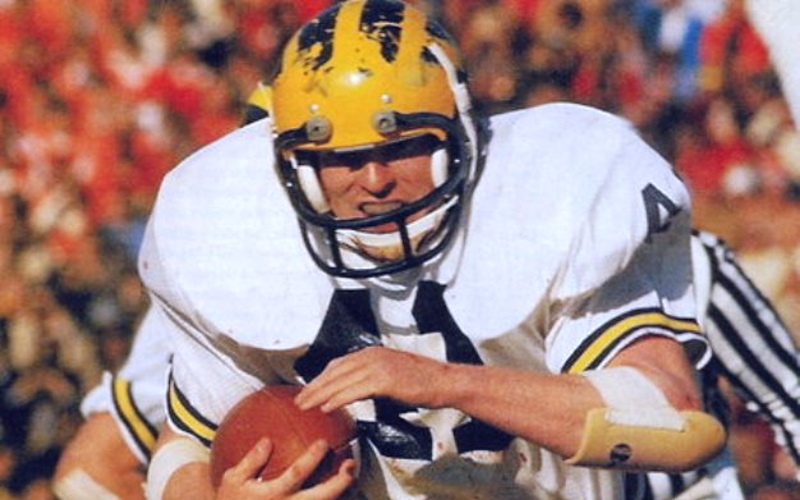
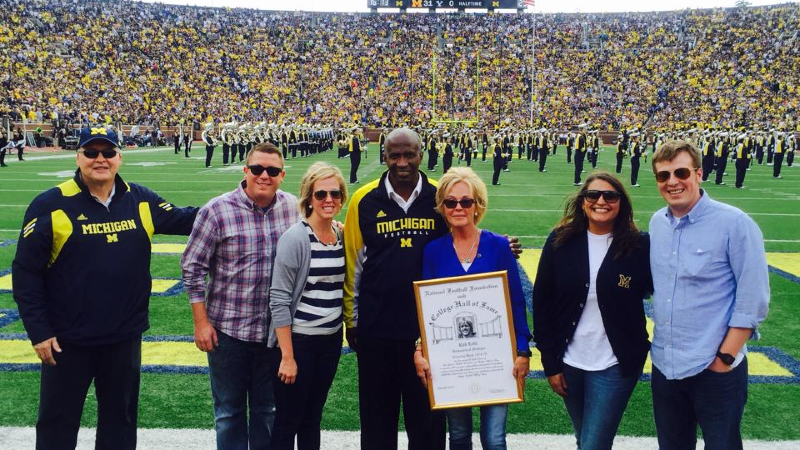
While at Michigan, Rob was a member of three Big Ten championship teams. He ran for 3,317 yards and scored 26 touchdowns. Rob currently ranks 8th in rushing yards in school history and 11th in all-purpose yards with 3,615 on 579 touches. As a senior in 1976, Rob ran for 1,469 yards, was named first team All-American, and the Big Ten’s Most Valuable Player. He finished third in that season’s Heisman Trophy balloting behind Pittsburgh’s Tony Dorsett and Southern California’s Ricky Bell. In 2015, the National Football Foundation inducted Rob into the College Football Hall of Fame.
Before his senior, All-American season, Bo asked Rob if he would play both fullback and tailback—requiring him to sacrifice carries, yards, and a shot at the Heisman Trophy—so they could maximize their talent on the field. Rob made the switch willingly. Michigan led the nation in total offense and won the Big 10 championship that season. Bo always preached, “The team, the team, the team.” Later, Bo would state many times that he felt Rob was the best teammate and toughest player he ever coached—perhaps the greatest praise Rob received for playing football.
Humility, self-sacrifice, and putting teammates above himself mattered to Rob. He loved football and lived to play the game.
We married on June 3, 1977, in Fremont. Since Rob was drafted in the second round by the Denver Broncos, we moved to Denver to begin our lives. Rob was fortunate to spend all 7 years of his professional career with Denver. As a rookie, he scored a touchdown in Super Bowl XII. Even though Denver lost to Dallas, it was an exciting moment in our lives.
While a Bronco, Rob worked at Cotrell’s Clothing Store in the offseason and involved himself in many charities. He served as honorary chairperson for the Listen Foundation, worked with the United Way, and helped with the Special Olympics. He was a fixture at fundraisers during those years.
Injuries filled Rob’s professional career, and it seemed we lived in operating rooms and hospitals. He always worked to overcome them, though, and return to the game he loved. Still, the body—and mind—can only bounce back so many times before it screams no more. In 1984, Rob’s final knee operation was more than his body could conquer. While playing for Denver, Rob scored 14 career touchdowns and ran for 1,451 yards to go along with 562 receiving yards. He reached the pinnacle of his profession, but left regretting that injuries kept him from ever playing to the level that he knew he could reach.
We returned to Fremont in 1984, where Rob worked in his family’s 5th generation men’s clothing store. Retirement was difficult for Rob. Though his heart longed to continue playing, his body could no longer take the physical toll of football. On many nights in the first years after leaving football, we would retreat to the couch after Erin and Kelly had fallen asleep and Rob would sob as I held him. He missed football, but even more he missed the purpose and direction the sport gave him. He believed that he had failed, despite playing seven seasons in the NFL, because he never achieved the impossible goals he had for himself. Over time, we put the pieces together, but Rob’s longing for the game never faded.
Rob closed his family’s store in 1989, and then worked for Bowlus Trucking and Turner Construction. Rob later became involved in the banking business and was vice president and business development officer for a regional bank in Northwest Ohio when he died.
During these years, Rob was a wonderful father and friend. We spent every Sunday with Erin, Kelly, and friends in some pick-up game of softball or football. The lasting memory of Rob for so many people is seeing him with a big smile on his face, surrounded by laughter, and immersed fully in a game or activity with his kids.
Once again, Rob became involved in the community. He was a Rotary president, YMCA board member, and assistant football coach. He served on the board of his favorite organization, the Sandusky County Board of Developmental Disabilities, and they even named their new facility after him because of all the support he gave.
Rob was blessed with a kind and genuine spirit. He invested himself in helping others, and lived his life filled with passion. Rob always wanted to make a difference in people’s lives while striving to include them and put a smile on their faces, which he could almost always do thanks to his sense of humor. Rob believed that every person was important and had a story to tell. He taught our children to be kind, considerate, compassionate, and to care for others. Rob filled our children’s hearts and minds with pleasant memories of meaningful times spent together.
We remember Rob as a loving father who shared the fun and pain of raising a family. Rob always listened, loved, and helped. More than anything else, he loved his family.
Rob wasn’t perfect, but he tried with everything he had.
George Macinko
John Mackey
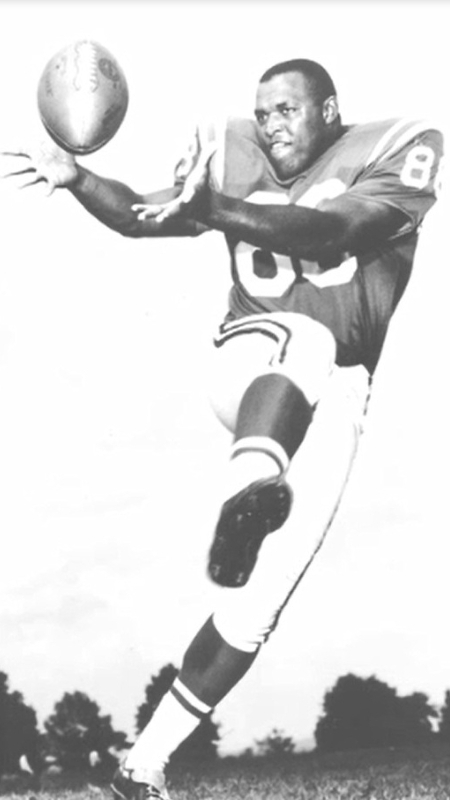
John Mackey made a difference – in football, in business, and in life. A star tight end at Syracuse University, his impact was so significant that the university retired his jersey number – 88 – in his honor in 2007. While at Syracuse, he quietly and peacefully made inroads into the discrimination that permeated society, building lifelong friendships that transcended ethnicity and socioeconomic backgrounds.
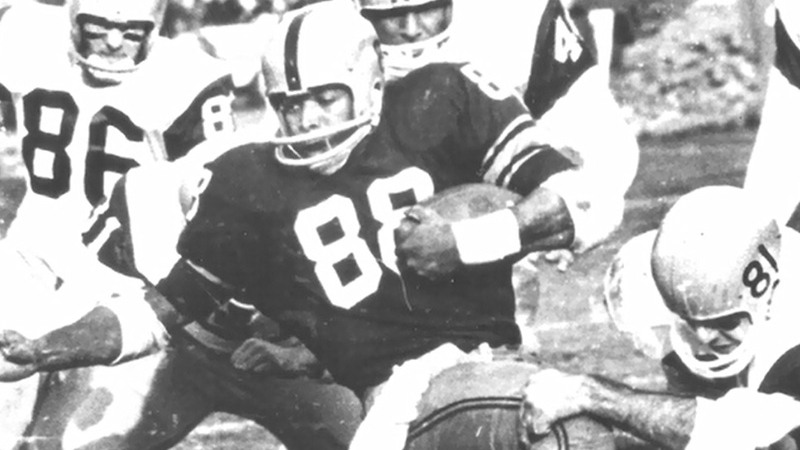
Selected by the Baltimore Colts in the second round of the 1963 draft, John played nine seasons with the Colts before finishing his playing career with the San Diego Chargers in 1972. In 10 seasons in the NFL, he earned Pro Bowl honors five times, including his rookie season. In 1992, he was inducted into the Pro Football Hall of Fame, only the second at his “revolutionized” tight end position to be so recognized. To this day, Mike Ditka – the first tight end to be inducted in the Hall of Fame – describes John as the greatest to ever play the game.
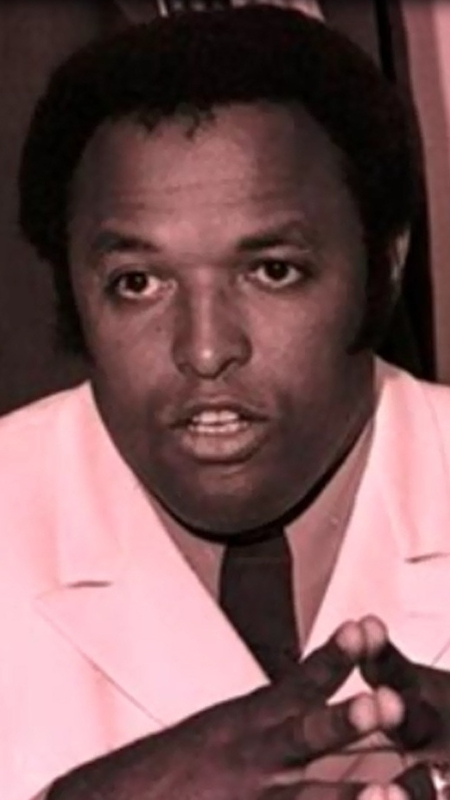
In 1970, John became the first president of the National Football League Players Association following the merger of the NFL and AFL. He spent the next three years leading the union through turbulent times, fighting for better pension and disability benefits for players, and gaining free agency that today’s NFL players still enjoy. It was a battle that some contend kept him out of the Pro Football Hall of Fame for 15 years.
Off the field – and for nearly three decades after his football career ended – John was as committed to advocating for those in need as he was to football – and in particular, Syracuse University and the Syracuse Orange, and Baltimore and the Baltimore Colts. Although he and former U.S. Congressman Jack Kemp (an NFL veteran himself) had different political perspectives, they partnered to launch a non-profit to give an educational advantage to disadvantaged children. He actively supported the civil rights movement that changed the course of history. He reached out to others, whether it was to offer guidance on career choices or to advocate for recognition of an under-appreciated teammate. At John’s funeral in 2011, in fact, his Syracuse teammate, former Denver Bronco Floyd Little, told mourners what John wrote to the Pro Football Hall of Fame in support of Floyd’s candidacy: “If there’s no room for Floyd Little in the Hall of Fame, please take me out and put him in.”
That’s the kind of person John Mackey was.
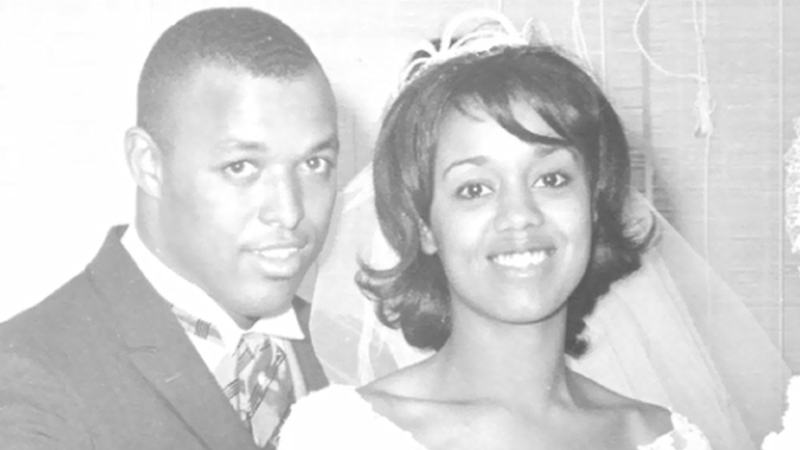
He was also my college sweetheart. We started dating as freshmen at Syracuse, thanks in part to our friend Ernie Davis, a teammate of John’s who loaned him the money to pay for our first date. John and I married in 1964, raised a son and two daughters together, and had just begun to enjoy our grandchildren when John was diagnosed with frontotemporal dementia. He was just 59 years old.
Until then, I thought we would grow old together. I thought we would watch our children’s children grow up. Instead, over the last 11 of our 47-year marriage, I watched the love of my life lose every memory of the family, the friends, and the game he treasured. Over those 11 years between his diagnosis and death, the compassionate person who cared so much for others, the man who stood up for the underdog, the mentor who provided guidance to so many young people, the citizen who gave back to the community – the loving husband, father, and grandfather – slowly regressed to a childlike adult.
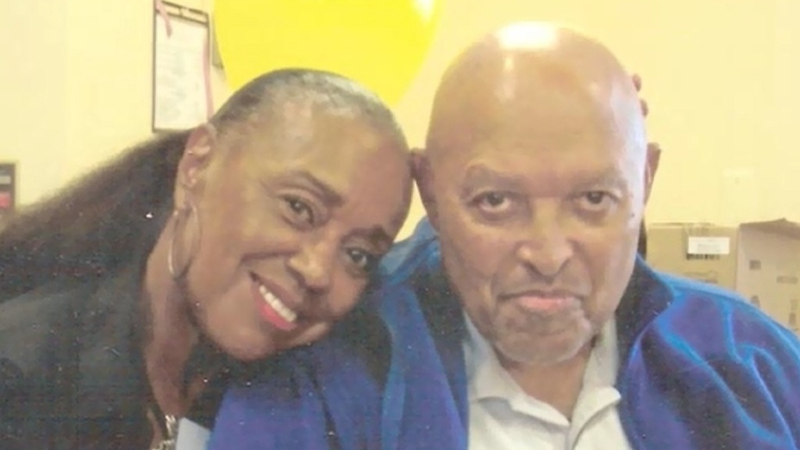
Despite the ravages of the disease, there was one constant in John’s mind – he was a Baltimore Colt. When his disease progressed to the point where hygiene became an issue, a fake message from the NFL’s then-commissioner Paul Tagliabue convinced John to brush his teeth. He proudly wore his Super Bowl V and Pro Football Hall of Fame rings, yet it was absolutely heartbreaking to hear him ask friends and fans alike, “Do you want to see my rings?” Even in the fog of dementia, the Baltimore Colts and the National Football League broke through.
Although dementia robbed John of his powerful voice, the disease gave him the ability to influence the discussion about head trauma, to inform active and former players about the dangers, and to impact the future of sports medicine and player safety. His private battle with dementia became the public face of the link between head trauma, chronic traumatic encephalopathy, and related ailments. He was the catalyst for the 88 Plan that provides financial assistance for those affected, for the advocacy and fundraising efforts of his Baltimore Colt teammates that changed the conversation from blaming the player to protecting the future, and for my own involvement in the Concussion & CTE Foundation. When John died on July 6, 2011, a few months shy of his 70th birthday, the widespread media coverage focused as much on these and other post-diagnosis accomplishments as on any of his other achievements in life. Even in illness and in death, he changed the world.
That, I believe, is John Mackey’s greatest legacy. What will your legacy be?
Sylvia Mackey
Mrs. #88
Greg Marx
Ollie Matson
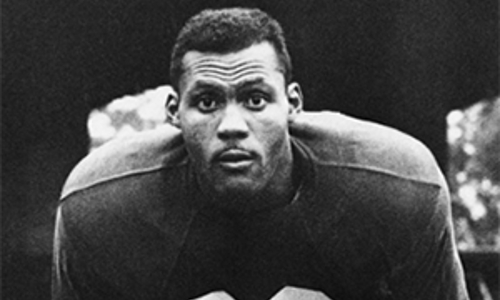
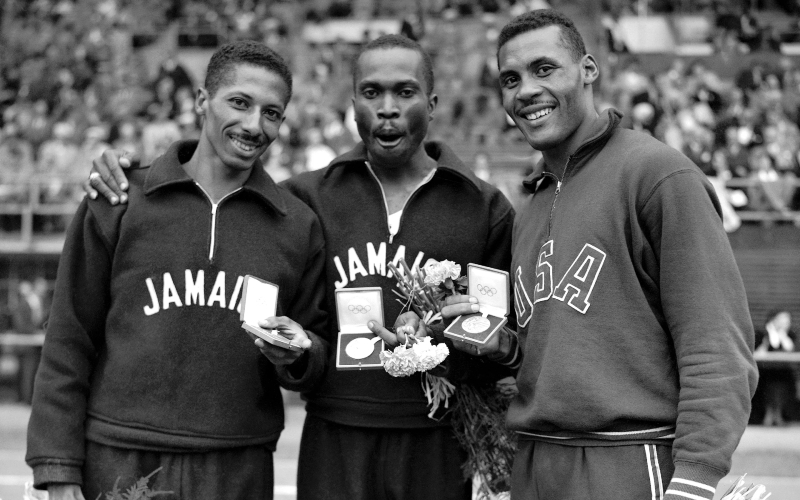
Most athletes can only dream of reaching the pinnacle in just one sport, let alone two. Ollie Matson was not like most athletes, however. Not only is he a member of both the College Football Hall of Fame and the Pro Football Hall of Fame, he also won two Olympic medals with the U.S. Olympic track and field team in 1952.
Matson started playing football as a freshman at George Washington High School in San Francisco before joining the University of San Francisco Dons as a star two-way player. He was a 1951 Heisman Trophy finalist following his senior season, when he led the country in both rushing yards and touchdowns. While Matson finished ninth in Heisman voting, his performance led the Chicago Cardinals to select him third overall in the 1952 NFL Draft. Matson went on to play 14 seasons for the Cardinals, Rams, Lions, and Eagles. Throughout his career, Matson was a six-time Pro Bowler, and his 12,799 career all-purpose yards at the time of his retirement ranked second all-time only to Jim Brown. Matson is a member of the NFL 1950s All-Decade Team and was inducted into the Pro Football Hall of Fame in 1972 and the College Football Hall of Fame in 1976.
Upon retiring from football, Matson joined the Los Angeles Memorial Coliseum as its director of special events, where he remained until retirement in 1989. Outside of work, Matson dedicated his life to others. He was a passionate volunteer who spent much of his free time mentoring children, especially those in juvenile hall and corrections. Matson also served as a football coach for nearby Los Angeles High School.
But family always came first and foremost.
“My grandfather was a gentle giant, soft-spoken and disciplined,” said Matson’s granddaughter Lara Parker. “He made sure to spend time with all of his children and grandchildren, even though they were scattered throughout the country.”
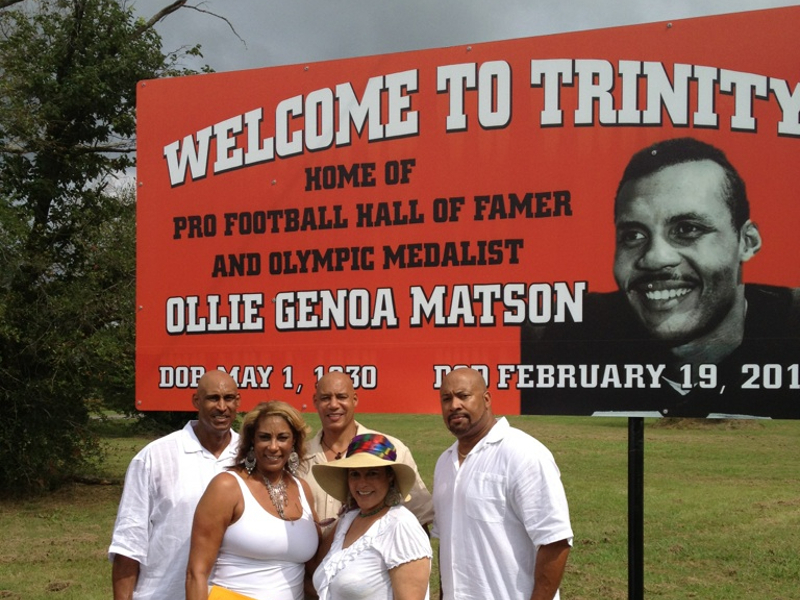
In addition to being with family, Matson followed a strict daily routine of his favorite activities, including cooking and gardening. He stayed active by walking every day from his home to L.A. High School and back. He also loved watching horse racing but had to stop when his memory began to worsen, as he would forget how to return home from the track.
Once Lara graduated from college, she moved back to Los Angeles to help take care of her grandfather, who had been diagnosed with Alzheimer’s disease. As the only person around him full-time, Lara was able to see his changes firsthand. Though Matson never talked about the injuries he sustained while playing football, his wife and twin sister often commented on the amount of hits he took. There were occasions he stayed in bed for days with a headache, only to take the field again as if nothing happened. One particular college game comes to mind: a 1951 matchup against the University of Tulsa. Matson was specifically targeted and hit by the other team for being a Black player.
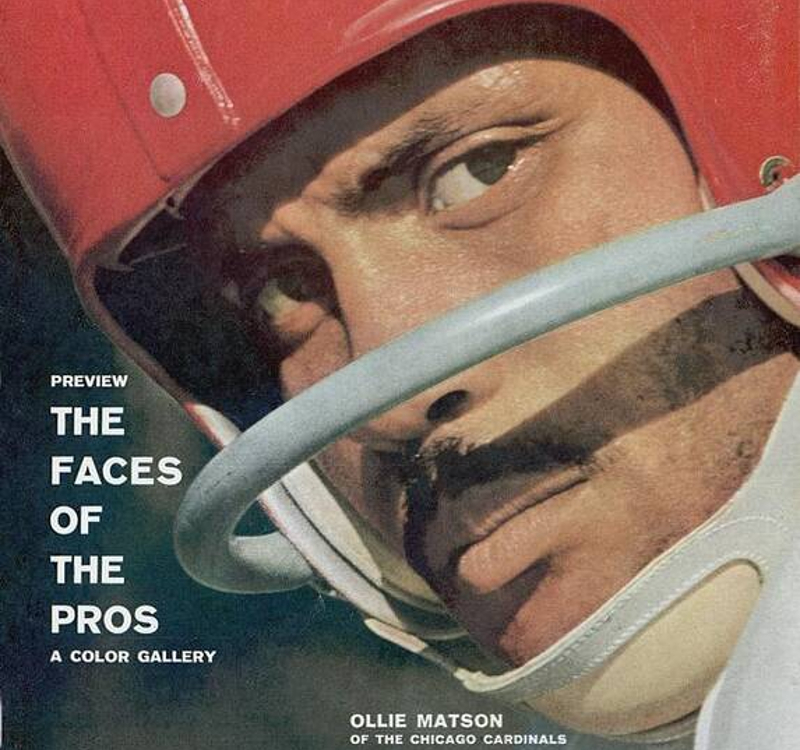
The always determined Matson slowly started acting in unrecognizable ways, becoming almost childlike at times. Once he reached his 70s, he could no longer drive and did not have the capacity to stay active. There were moments he would forget how to do simple tasks like taking a shower. Matson would get down to play with his grandchildren, but not have the strength to get back up. And though he remained stubborn, he fortunately was never aggressive or physical around people. While Matson’s family originally attributed his decline to Alzheimer’s and old age, they sensed something else more serious might be in play, as news about former football players diagnosed with CTE became widespread.
After Matson’s death in February 2011 at the age of 80, his family made the decision to donate his brain to the UNITE Brain Bank. Researchers diagnosed him with stage 4 (of 4) CTE and noted it was one of the most severe cases they had seen at that time. In fact, they were shocked he was able to survive so long in his condition.
“We discussed the donation before his death, suspecting he was in the end stage of CTE,” said Lara. “The hope was to help future families from suffering like we did.”
Though the Matson family wasn’t surprised by the diagnosis, they were startled by the severity. Because Matson mostly kept everything to himself, they didn’t know how much he was struggling.
“He must have known something was wrong but couldn’t express it,” said Lara. “Was he depressed? Sad? Frustrated? It’s painful to know the strongest person you know was suffering internally and we couldn’t help.”
Lara and the rest of the Matson family want other families who may be in a similar situation to learn from their experience. They are strong supporters of the Concussion & CTE Foundation’s Stop Hitting Kids in the Head campaign, which aims to convince sports to eliminate repetitive head impacts under the age of 14 to prevent future cases of CTE. She urges other parents to reevaluate their young children’s involvement in contact sports and the potential risks of pursuing this path.
“Ultimately, we want Ollie’s donation to help further this crucial research so we can truly understand the impact of concussions and related traumatic brain injuries,” said Lara. “We also want others to know no matter how bad something may seem, you’re not alone, and there is a strong network of other families like ours who understand.”